
As an chirurgien oculoplasticien specializing in the gaze for over twenty years, I meet daily with patients who come to see me because they have swollen eyelids.
This eye swelling, whether it appears in the morning upon waking or persists throughout the day, represents one of the most frequent consultations in our practice. Studies show that nearly 40% of patients over 40 years old consult for issues related to eyelid aging, and many of them first describe their swollen eyes as a sign of permanent fatigue that affects their daily lives and their self-confidence.
Swollen eyelids can have multiple causes, and this is precisely why I always take the time to listen to you carefully during our first meeting.
It may be a simple eyelid edema related to water retention, hereditary fat pads that become more pronounced with time, or excess skin that gives this heavy and tired look. Sometimes swollen eyes in the morning come from fluid accumulation during the night, and sometimes it is the tissue structure itself that changes with age. In all cases, understanding the origin of your swollen eyelids is the first step toward a personalized solution.
When you walk through the door of our practice in Paris, I guarantee you an approach that respects your uniqueness. Each patient presents a unique anatomy, and the treatment of swollen eyes cannot in any way be standardized.
Our experience in eyelid & oculoplastic surgery allows us to offer you, after a thorough examination, tailored solutions ranging from medical treatments to surgical procedures such as blepharoplasty, depending on the nature and intensity of your eye swelling.
My role is to clearly explain what is happening with your eyelids, to reassure you about existing solutions, and to guide you toward a care approach that suits you.
Results vary from one patient to another, which is why every project is discussed during consultation to define together the best strategy. I invite you to continue reading to discover the different approaches we can implement for swollen eyelids.
Why do I have swollen eyelids in the morning?
We find that eyelid swelling upon waking is an extremely common phenomenon that affects most of us at some point. This normal situation is explained by the natural fluid retention mechanisms that occur during sleep.
The nocturnal fluid retention process
When you sleep, your body remains in a horizontal position for typically 6 to 8 hours.
In this position, gravity no longer plays its usual role in draining fluids toward the lower body. Fluids tend to accumulate in the thinnest and least dense tissues, and the delicate skin of the eyelids is particularly affected.
Lymphatic circulation, which normally helps eliminate excess fluid, slows considerably during sleep.
This combination of factors favors what doctors call transient palpebral edema. The blood capillaries around the eyes become slightly more permeable during the night, allowing slightly more fluid than usual to pass into the tissues.
Upon waking, you may therefore observe swollen eyes, particularly in the upper eyelids and sometimes bags under the eyes.
This swelling is generally temporary and naturally decreases in the minutes or hours after you get up, as you straighten up and circulation reactivates. Generally, it takes between 30 minutes and 2 hours for the swelling to completely disappear in most people.
Risk factors for morning swelling
Certain factors increase the likelihood of waking up with swollen eyelids.
Evening salt consumption promotes water retention throughout the body, including in the face. Similarly, drinking alcohol before bed contributes to dehydration followed by compensatory fluid retention that follows.
Lack of sleep or poor-quality sleep disrupts the fluid regulation mechanisms.
People who sleep on their stomach or side sometimes experience more swelling because this position favors fluid accumulation in the face. Finally, women may notice an accentuation of this phenomenon according to their hormonal cycle.
These physiological explanations show that swollen eyelids in the morning are not necessarily a sign of a health problem. Most of the time, this is a natural and temporary process.
Causes of swollen eyelids: from common to pathological
Swollen eyelids represent a very common reason for consultation. In the vast majority of cases, this temporary swelling remains benign and disappears spontaneously within a few hours or days.
However, it can sometimes reveal an underlying condition requiring specific management. Understanding the various origins of this symptom will help you better evaluate your situation and know when to seek consultation.
Common and benign causes
The most frequent cause of swollen eyes remains lack of sleep.
When you do not get enough sleep, lymphatic circulation around the eyes slows down, leading to fluid accumulation in the eyelid tissues. This phenomenon explains why you often notice eye swelling upon waking, especially after a short or restless night. Generally, this type of morning eyelid swelling disappears within two hours of getting up.
Fluid retention is also a determining factor.
A diet too high in salt, hormonal fluctuations in women, or simply lying down during the night promote fluid accumulation in the eyelids, which are particularly thin and vascularized areas. Prolonged crying triggers local inflammation that can persist for several hours.
Allergies also represent a frequent cause of eye swelling.
Pollen, dust, cosmetics, or household products can cause an inflammatory reaction in the eyelids. This swelling is generally accompanied by itching and redness. In this case, symptoms often appear suddenly and may affect both eyes simultaneously.
Medical causes to monitor
Certain eyelid swellings should prompt you to consult a physician. Thyroid problems, particularly hypothyroidism, may present with thickening of the eyelid tissues.
Kidney disorders, particularly nephrotic syndrome, cause generalized edema that particularly affects the face upon waking. These conditions are generally accompanied by other symptoms such as intense fatigue, weight changes, or urinary problems.
Congestive heart failure may also manifest as edema in the lower limbs but also in the face, particularly noticeable in the morning. In all these cases, eye swelling involves not only the eyelids but the entire periorbital area.
Associated ocular pathologies
Certain specific eye conditions cause characteristic swollen eyelids.
Conjunctivitis, whether viral, bacterial, or allergic, causes inflammation of the membrane lining the eye and the inside of the eyelids. The swelling is accompanied by redness, itching, and sometimes discharge.
A stye is a bacterial infection of an eyelash or an eyelid gland.
It presents as a painful, red, swollen nodule, often located at the edge of the eyelid. Blepharitis, chronic inflammation of the eyelid margins, also causes persistent swelling accompanied by scaling and itching.
In all cases, if the swelling persists for more than a few days, worsens, or is accompanied by pain, vision problems, or general symptoms, a medical consultation is essential to establish an accurate diagnosis.
Swollen Eyelids: When to Worry and Seek Emergency Care
Swollen Eyelids: When to Worry and Seek Emergency Care
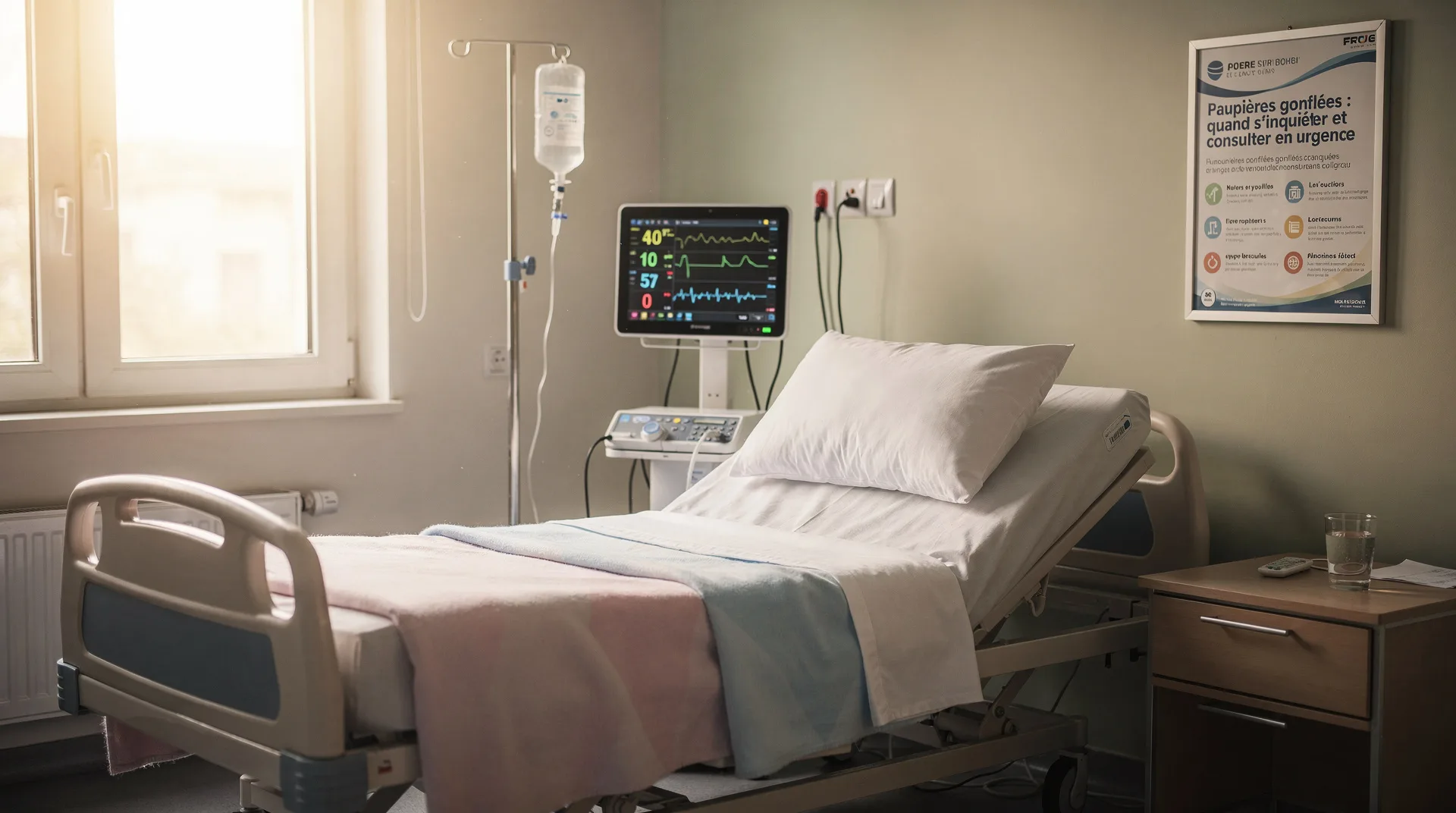
The majority of swollen eyelid episodes are benign and resolve spontaneously within a few hours, often during the course of the morning.
However, there are situations where this symptom should prompt you to seek medical attention quickly. Understanding the difference between an urgent situation and a scheduled consultation will allow you to react appropriately without giving in to excessive worry.
Warning Signs Not to Ignore
Certain signs accompanying your swollen eyelids should alert you immediately. If you experience decreased vision, significant pain, intense redness of the eye, or are unable to fully open the eye, seek medical attention without delay.
Similarly, if the swelling does not decrease after several hours or progressively worsens, it is advisable to seek advice from a professional. The presence of fever, pain around the eyes, or unusual discharge also constitutes a warning sign that should be taken seriously. In these cases, an emergency consultation may be necessary to rule out more serious causes such as an infection or a therapeutic issue.
Swollen eyes accompanied by breathing difficulties or swelling of the entire face may indicate a severe allergic reaction and require immediate medical attention.
If you have received a blow to the eye area recently, even a minor one, and the swelling persists beyond 48 hours, medical advice is recommended to ensure no injury has been overlooked.
Difference Between Emergency and Scheduled Consultation
The distinction between a medical emergency and a scheduled consultation is based on the presence of associated symptoms and the progression of the swelling.
Swollen eyelids in the morning, related to overnight fluid retention, are generally normal and do not warrant emergency consultation. This phenomenon, often amplified by prolonged lying down position, typically decreases within hours of getting up.
However, if your swollen eyes upon waking persist beyond several hours without improvement, or if the swelling is asymmetrical and very pronounced on one side, a consultation with your general practitioner or an chirurgien oculoplasticien within the following days will be sufficient.
The latter can identify the cause of the problem and propose appropriate treatment, whether antibiotic treatment in case of infection, eyelid care in case of blepharitis, or simply ocular hygiene recommendations.
In all cases, your instinct remains your best guide. If you feel genuine concern regarding the sudden appearance of swollen eyelids, do not hesitate to contact your physician or an on-call service who can guide you toward appropriate care.
Relieving Swollen Eyelids: Remedies and Prevention
Immediate Natural Solutions
When you wake up with swollen eyes, several simple steps can help reduce the swelling quickly. The first thing to do is apply a cold compress to your closed eyelids for about 10 to 15 minutes.
Cold constricts the blood vessels and helps decongest the area. You can use a washcloth soaked in cool water or cold packs designed for this purpose. It is recommended to repeat this 2 to 3 times in the morning for optimal results.
Cool water is also an excellent reflex. Rinsing your face with cool water several times a day stimulates circulation and promotes the resolution of palpebral edema.
Elevating your head during sleep, using an extra pillow, limits fluid accumulation in the eyelids overnight. This position prevents blood from pooling in the eye area and significantly reduces swelling upon waking.
0 Comments