
Xanthelasma of the eyelids represents one of the most frequent consultations in our eyelid & oculoplastic surgery practice in Paris.
These small yellowish plaques that appear on the eyelids, often near the inner corner of the eye, can cause genuine aesthetic distress in my patients. Approximately 50% of people with xanthelasma have an underlying lipid disorder, which is why this cutaneous manifestation deserves particular attention from both an aesthetic and medical standpoint.
When you notice the appearance of these yellowish deposits on your eyelids, it is perfectly normal to question their nature and treatment.
Xanthelasma corresponds to an accumulation of lipids beneath the skin, a generally benign phenomenon but sometimes revealing a blood cholesterol imbalance. In our practice, we take the time to listen to each patient carefully, because beyond the aesthetic aspect, understanding the origin of these lesions allows us to adapt management and follow-up.
The definitive treatment of xanthelasma is among the most common treatment requests we receive.
Several options exist: eyelid aesthetic surgery, also called blepharoplasty, allows for the complete removal of xanthelasma when the lesions are well-defined. We favor minimally invasive techniques that preserve eyelid sensitivity and mobility, with natural results that respect the harmony of your gaze. The choice of treatment depends on the size of the lesions, their location, and your skin type.
In this article, I invite you to discover how we approach eyelid xanthelasma in our practice, what examinations to perform before any intervention, and what the postoperative course entails.
Our goal is to accompany you with transparency toward an informed decision, in a reassuring and personalized setting. As each patient is unique, the results described are indicative and may vary according to your particular clinical situation.
Understanding Xanthelasma: Causes and Mechanisms
What is Eyelid Xanthelasma?
Xanthelasma of the eyelids corresponds to lipid deposits that accumulate under the skin of the eyelids, usually near the inner corner of the eye. These small yellowish plaques, often slightly raised, are made up of cholesterol and triglycerides. They most often appear on the upper eyelid, but can also affect both eyelids.
Although these lesions are completely benign from a medical standpoint, they represent a significant aesthetic concern for patients who suffer from them. Eyelid xanthelasma develops gradually over several months, or even several years, and its size can vary from a few millimeters to several centimeters. It is important to distinguish this condition from other eyelid lesions such as chalazia or cysts, as the management will be different. The diagnosis is generally clinical and does not require systematic additional tests, unless a metabolic cause is suspected.
Link to Cholesterol and Metabolism
Eyelid xanthelasma is not simply an aesthetic coincidence: it often reflects a lipid metabolism disorder. Approximately 50% of patients with xanthelasma have abnormalities in their lipid profile, particularly elevated total cholesterol or LDL cholesterol levels. These deposits form when cholesterol circulates in excess in the blood and penetrates into the macrophages of the eyelid skin, which then transform into characteristic foam cells.
The link between eyelid xanthelasma and metabolic disorders explains why these lesions can sometimes partially regress during effective treatment of lipid abnormalities. However, spontaneous regression is rare, which is why many patients seek how to remove xanthelasma definitively. We recommend performing a complete biological assessment including total cholesterol, LDL, HDL, and triglycerides as soon as xanthelasma appears, even in the absence of other clinical signs.
Risk Factors and Predispositions
Several factors favor the appearance of eyelid xanthelasma. Age is a determining factor: the majority of lesions appear after 40 years of age, with increasing prevalence after 60 years. Women are more frequently affected than men, suggesting a hormonal component. Poorly controlled diabetes and obesity also represent significant risk factors, as they worsen metabolic disorders.
Finally, a genetic predisposition exists: some patients develop xanthelasma despite a normal lipid profile, suggesting individual sensitivity of eyelid tissues to cholesterol. Knowledge of these factors allows for a preventive approach: weight control, diabetes management, and a balanced diet help limit the progression of existing lesions and prevent the appearance of new xanthelasmas.
Xanthelasma Diagnosis: When to Consult?
Eyelid xanthelasma appears as small yellowish patches, generally flat or slightly raised, most often located on the upper eyelids, near the inner corner of the eye. These lesions are often bilateral and symmetrical.
Their size can range from a few millimeters to several centimeters. If you notice the appearance of such yellowish patches on your eyelids, we recommend consulting a physician or dermatologist. Although xanthelasma is generally benign and painless, its presence may indicate an underlying metabolic disorder that should be identified.
Characteristic Signs and Differential Diagnosis
The diagnosis of eyelid xanthelasma is primarily based on clinical examination. The physician observes yellow-orange plaques that are soft to the touch, typically located on the upper eyelid near the inner angle of the eye. These lesions are generally asymptomatic and progress slowly.
Differential diagnosis includes other eyelid lesions such as chalazia, epidermal cysts, or certain benign tumors. In most cases, the clinical appearance is sufficient to establish the diagnosis. However, if the appearance is atypical, a biopsy may be performed to confirm the xanthomatous nature of the lesion.
Recommended Additional Tests
When the diagnosis of eyelid xanthelasma is confirmed, additional tests may be prescribed to evaluate the patient’s overall health status.
A complete lipid panel is generally recommended, including total cholesterol, LDL cholesterol, HDL cholesterol, and triglycerides. This testing allows for the detection of associated hyperlipidemia in a significant number of cases. Based on the results, further investigations may be considered.
Importance of Metabolic Assessment
The discovery of eyelid xanthelasma should not be considered merely a cosmetic concern. Approximately 50% of patients present with an associated lipid abnormality, particularly hypercholesterolemia or hypertriglyceridemia.
Metabolic assessment is therefore essential to tailor dietary recommendations and potentially treat an underlying disorder. This comprehensive management helps limit lesion progression and reduce cardiovascular risks associated with lipid abnormalities. Your physician can guide you toward definitive treatment of the xanthelasma if you wish, after evaluating your overall situation.
Definitive treatments for xanthelasma: what permanent solutions?
Fractional CO2 laser: technique and indications
The fractional CO2 laser represents one of the most modern approaches today for treating eyelid xanthelasma definitively. This technique works by creating microscopic heat zones that destroy lipid deposits while preserving surrounding tissue. The laser also stimulates collagen production, which contributes to quality skin regeneration.
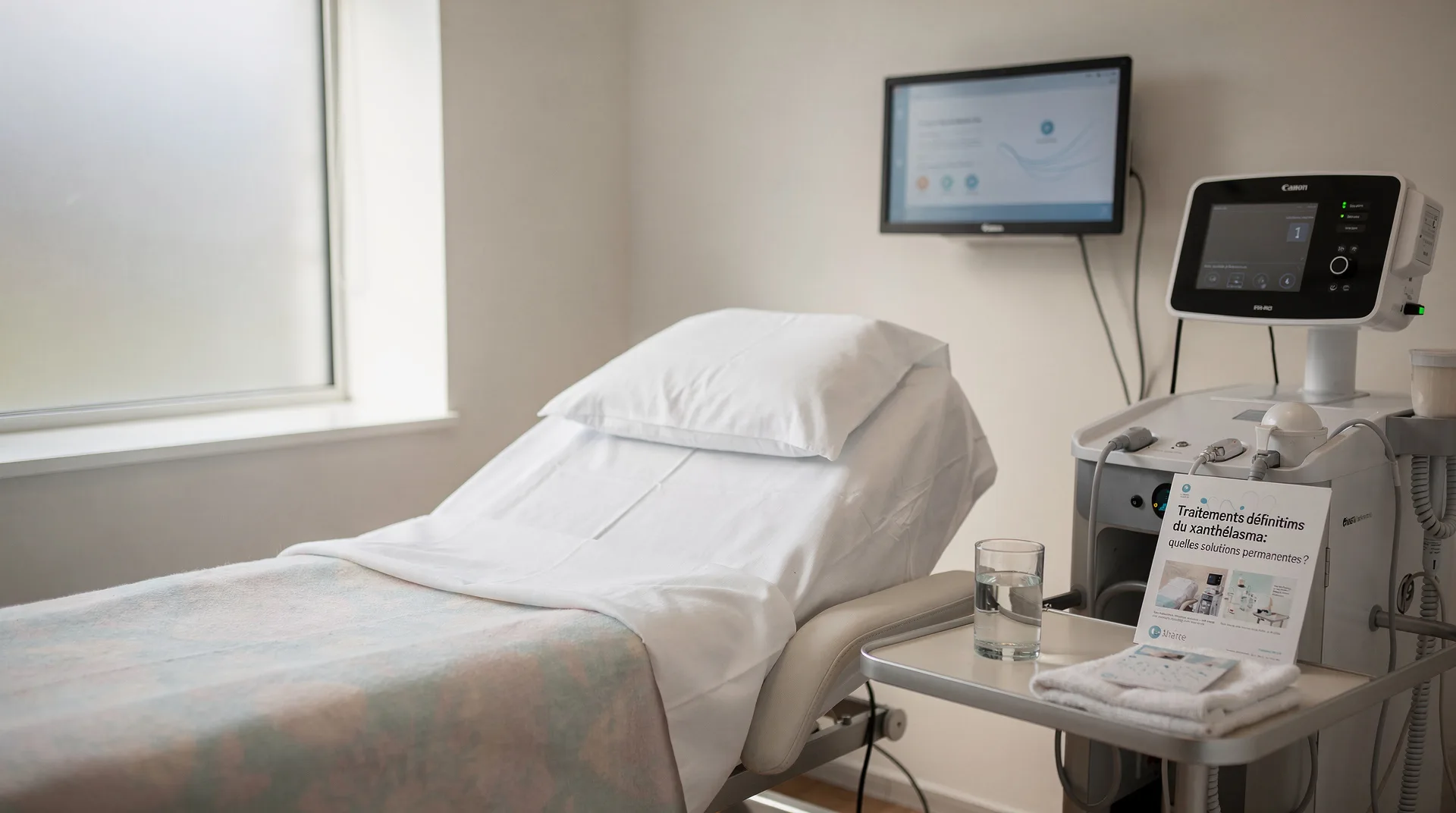
Generally, one to three sessions spaced four to six weeks apart are sufficient to achieve a satisfactory result. The duration of each session varies between ten and twenty minutes depending on the extent of the lesions. Post-treatment recovery is mild: temporary redness and small crusting may appear for a few days. This treatment is particularly suitable for small to medium-sized xanthelasmas, flat or slightly raised.
Surgical excision: for larger lesions
For large or particularly thick xanthelasmas, surgical excision remains the most appropriate solution. The chirurgien oculoplasticien removes the lesion entirely under local anesthesia, then sutures with a meticulous technique to preserve the natural appearance of the eyelid.
This method allows for complete removal of lipid deposits and provides a definitive result in most cases. Sutures are typically removed between five and seven days after the procedure. The cost of xanthelasma treatment by surgical excision depends on the complexity of the case and the duration of the procedure, which is why a personalized quote during consultation is always recommended. Recovery is slightly more significant than with laser, with mild swelling that resolves within approximately one week.
Comparison of techniques and indications
The choice between laser and excision depends on several factors that your chirurgien oculoplasticien will evaluate during the consultation. CO2 laser is better suited for flat, small lesions with a shorter recovery time. Surgical excision is preferable for large or longstanding xanthelasmas where the deposits are deeper.
In both cases, results are generally permanent, but it is important to understand that new xanthelasmas may appear on other areas of the eyelids. The overall cost varies depending on the technique chosen and the clinic, but you can expect to pay between three hundred and eight hundred euros per laser session, and double that for complete surgical excision.
Why isolated treatment is not always sufficient
Eyelid xanthelasma is often a symptom of an underlying metabolic imbalance, particularly lipid-related. This is why treating the lesion without addressing the cause may lead to recurrence. Approximately thirty percent of patients experience recurrence in the years following treatment, particularly those who have not corrected their lipid profile.
It is essential to undergo blood testing and, if necessary, follow medical treatment to normalize cholesterol and triglycerides. A balanced diet, rich in vegetables and low in saturated fats, also helps prevent the development of new lesions. Regular follow-up with your dermatologist or chirurgien oculoplasticien allows for early detection of any recurrence and prompt intervention if needed.
Prices and costs of xanthelasma treatment in France
The treatment of xanthelasma of the eyelids represents an oculoplastic surgery procedure whose cost varies depending on the technique chosen and the complexity of your case.
During your initial consultation, the chirurgien oculoplasticien will establish a personalized quote taking into account the number of lesions to be treated and the method most suitable for your situation.
Cost of laser treatment
Laser treatment is one of the most common approaches for removing xanthelasma. This technique uses precise light beams to destroy lipid deposits without incision.
Depending on the extent of the lesions and the number of sessions required, the fees vary considerably. The price of xanthelasma treatment by laser reflects the technical sophistication of the equipment and the expertise of the practitioner. A single session may be sufficient for small lesions, while more extensive cases sometimes require several appointments spaced a few weeks apart.
Surgical excision fees
Surgical excision remains the definitive treatment for xanthelasma, particularly effective for large or deep lesions.
0 Comments