
Are the results of eyelid blepharoplasty permanent?
Before / after
Real cases from the practice, unretouched, framed on the treated area only. Each result is individual and does not predict yours.
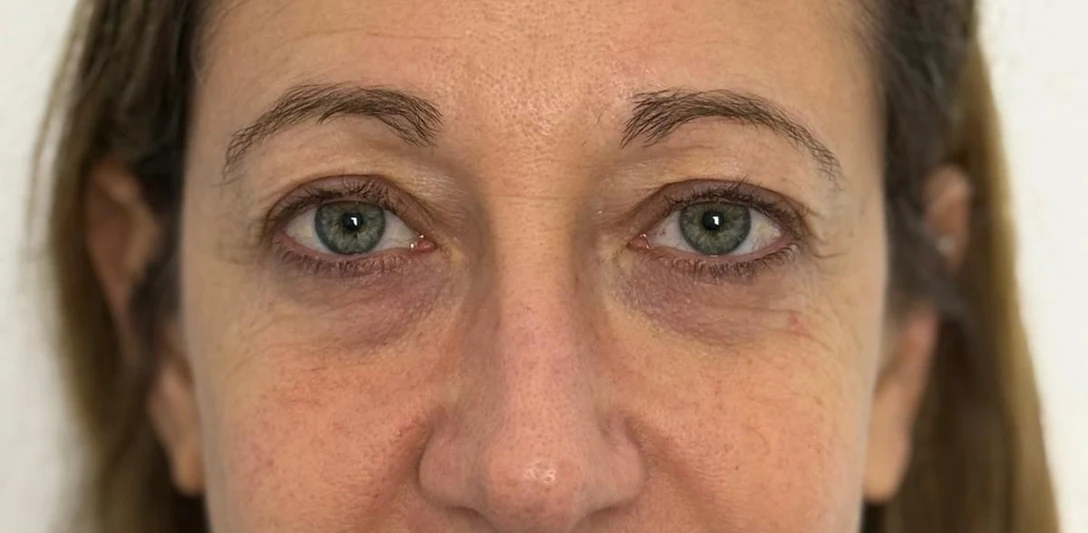
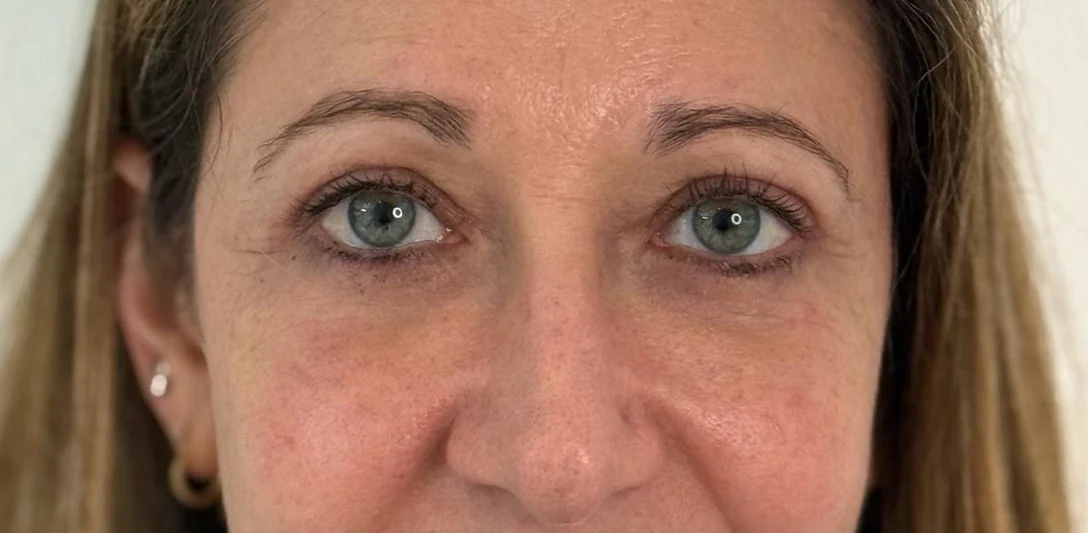
Photographs published with the patients’ written consent.
Written and reviewed by Dr Bernard Hayot, ophthalmologist, RPPS 10003926226.
What makes your face look tired and sad?
The main cause of sagging upper eyelids and under-eye bags is ageing, which is why blepharoplasty is not recommended before the age of 35. Certain illnesses or a paralysis can, however, also cause aesthetic problems in the eyelids at any age.
What is blepharoplasty in cosmetic surgery?
In cosmetic surgery, there are several types of blepharoplasty:
Lower blepharoplasty
Lower blepharoplasty is performed by a surgeon under local or general anaesthetic, depending on the patient’s needs. The surgeon operates on the eyelid through a transconjunctival approach, that is, from inside the lower eyelid, in order to remove excess fat. Suturing the conjunctival mucosa is not necessary in this type of blepharoplasty.
Upper blepharoplasty
Upper blepharoplasty is performed under local anaesthetic. The surgeon operates to remove excess skin and the internal fat pad of the upper eyelids. After the operation, the scars remain hidden in the natural crease above each eyelid. In the end, they are concealed to the naked eye. Sutures are needed for this type of blepharoplasty, and the surgeon removes them a few days after the operation.
Addition blepharoplasty, or lipofilling
Addition blepharoplasty is performed by a surgeon using a micrograft of fat aspirated beforehand from another area of the patient’s face. The aim of addition blepharoplasty is to harmonise the volumes of the eyelids by replacing the fat that is missing.
Pinch blepharoplasty
Pinch blepharoplasty is a minimally invasive procedure that removes excess skin from the lower eyelid by pinching it.
Is blepharoplasty reversible?
Blepharoplasty is not a reversible operation, which is why it is important to consult the surgeon beforehand, so that they can meet the patient’s needs as closely as possible. Touch-ups can nevertheless be carried out a few years after the operation if the eyelids sag further with age. It is also possible to inject hyaluronidase, an enzyme naturally present in the body, to correct a blepharoplasty that does not match the patient’s expectations, for instance in cases of over-correction or asymmetry.
What is the alternative to blepharoplasty? (medical blepharoplasty)
One alternative to blepharoplasty is medical blepharoplasty, which does not require surgery.
Medical blepharoplasty uses ultrasound to correct eyelid imperfections such as dark circles, puffiness and sagging. The procedure is non-invasive and painless, and in a single session it restores a youthful glow to the patient’s eyes.
This technique can be used on both the upper and the lower eyelids, and no anaesthetic is required.
This page is for information only. It does not replace a consultation: every situation is assessed on examination.