
Ptosis
Page reviewed on 4/09/2026 by Dr Bernard Hayot, ophthalmologist
Before / after
Real cases from the practice, unretouched, framed on the treated area only. Each result is individual and does not predict yours.
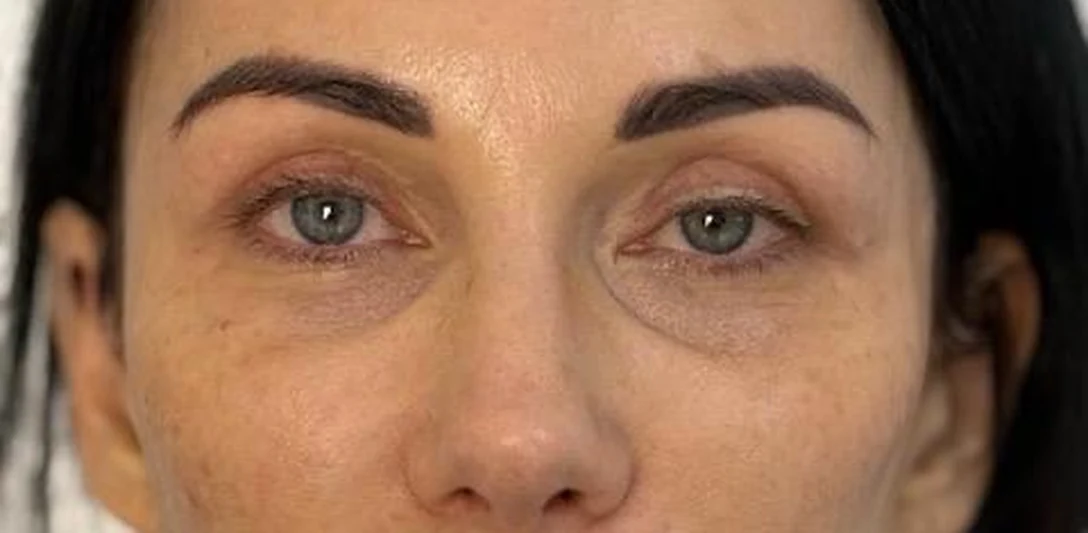
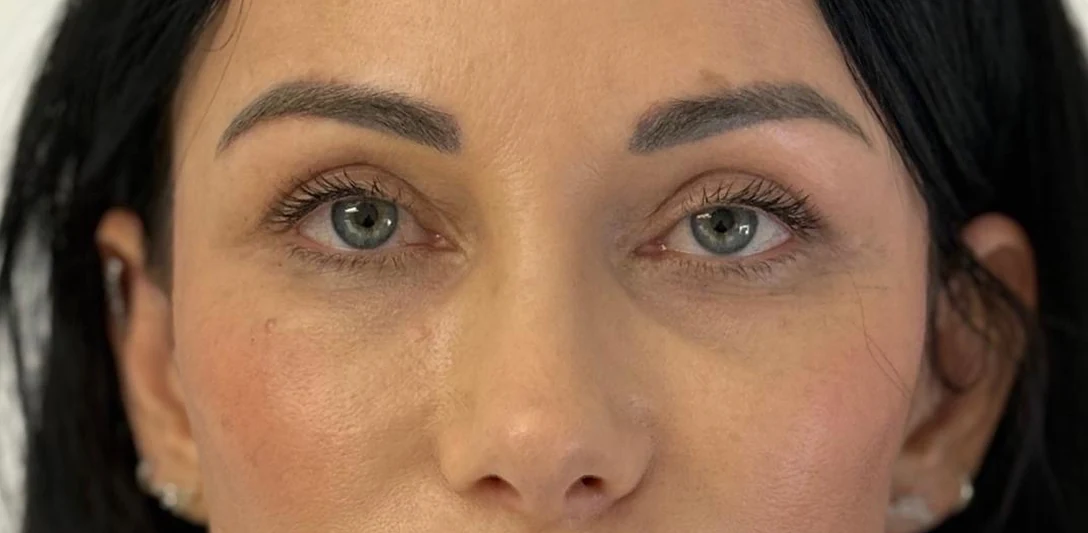
Photographs published with the patients’ written consent.
A drooping eyelid, an eye that looks smaller or more closed than the other: ptosis is a lowering of the upper eyelid. It stems from the levator muscle, not from the skin. Correcting it first requires a precise diagnosis, because excess skin, a lowered brow and a true ptosis resemble one another and are not treated in the same way.
To understand
What the studies say
A few figures published in peer-reviewed journals, chosen to give orders of magnitude. They do not describe your case: only the consultation does.
Ptosis of the upper eyelid is common with age: in a sample from a Korean national survey (KNHANES 2010-2012) covering 10,387 adults aged 40 and over, 15.8% presented with ptosis, defined by a margin-reflex distance of less than 2 mm. This survey mainly studied the association between cataract and ptosis.
Na et al., Scientific Reports, 2022 · PMID 35013495In a non-randomised retrospective series of 231 patients (372 eyelids) operated on for involutional ptosis, the success rate for the 142 eyelids with severe ptosis was 97.2% after resection of Müller’s muscle and the conjunctiva, compared with 77.4% after external levator muscle resection. As the patients operated on by the posterior approach were selected on their response to the phenylephrine test, this comparison does not allow the superiority of one technique to be concluded.
Sweeney et al., American Journal of Ophthalmology, 2020 · PMID 32387434In a series of 122 procedures for severe aponeurotic ptosis performed by the posterior approach, the overall success rate was 80.3%. The failures corresponded mainly to undercorrection (75% of unsuccessful cases).
Antus et al., Eye (London), 2017 · PMID 28776587In a cross-sectional study conducted in adults aged 50 and over, the prevalence of ptosis reached 27.2%, and older age, male sex, a higher fasting blood glucose and a lower frequency of physical activity were independently associated with it.
Hu et al., Aesthetic Plast Surg 2024 · PMID 38168822In a series of 51 eyelids operated on for involutional ptosis by external levator advancement, the success rate was 86%, and a positive preoperative phenylephrine test was significantly associated with a better result, including on symmetry.
Chaneac et al., Ophthalmic Plast Reconstr Surg 2024 · PMID 38771896In a series of 50 patients operated on for involutional ptosis and assessed by questionnaire six to eight weeks after the procedure, 16 of the 24 items analysed improved significantly in unilateral forms and 18 out of 24 in bilateral forms; the activities most improved were fine manual work, reaching for objects located above the line of sight, television and reading.
Battu et al., Am J Ophthalmol 1996 · PMID 8644811
On video
Dr Hayot explains this subject on video. Each video loads only when you click it.