
Upper blepharoplasty
Before / after
Real cases from the practice, unretouched, framed on the treated area only. Each result is individual and does not predict yours.
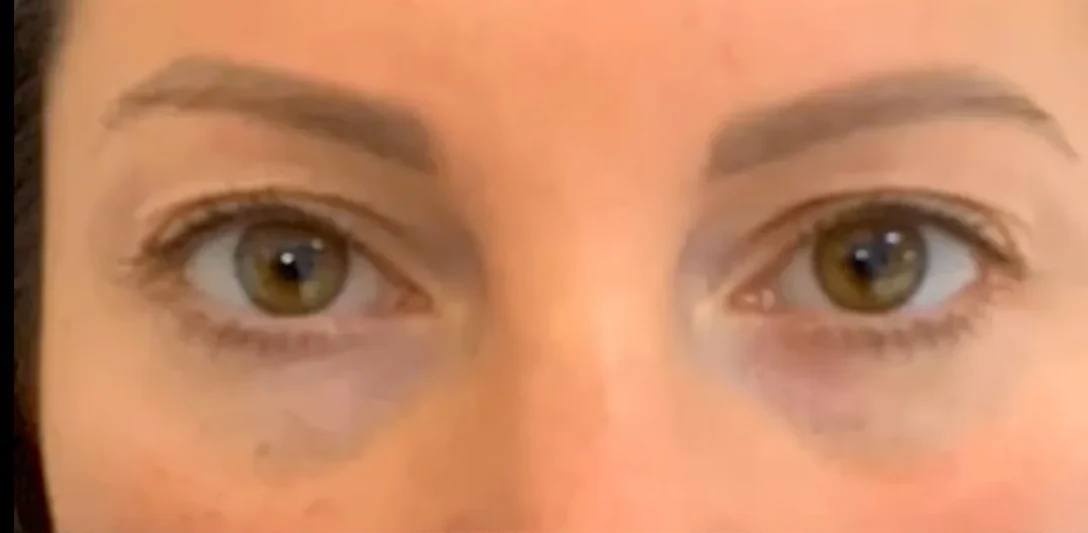
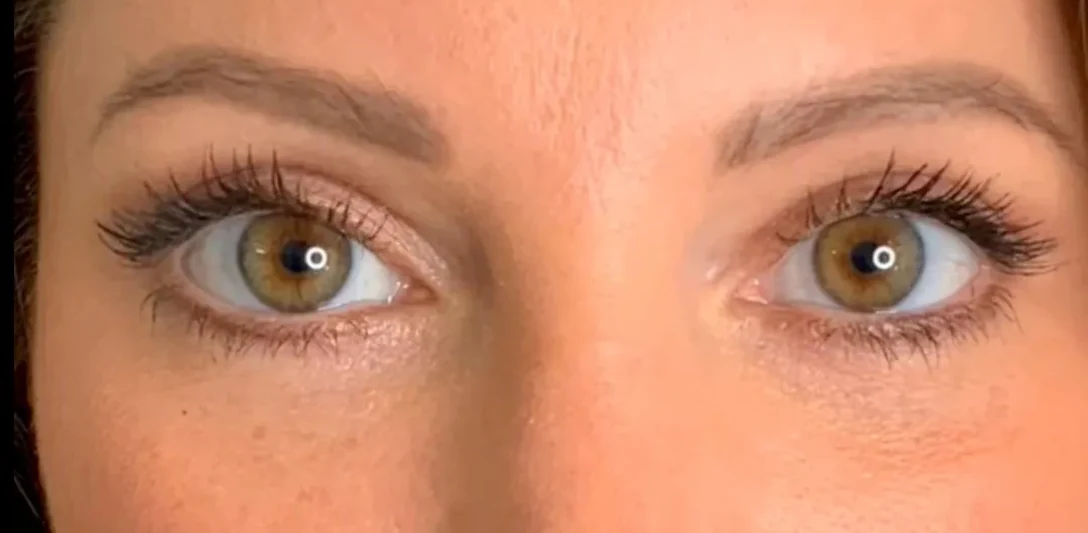
Photographs published with the patients’ written consent.

Dr Bernard Hayot, ophthalmologist, former chef de clinique, trained in oculoplastic surgery. Paris 8e · RPPS 10003926226.
Dr Hayot on video
Videos from the practice, loaded only on click (YouTube without cookies).
Cosmetic surgery of the upper eyelid
Upper blepharoplasty is the most frequently performed eye surgery. Yet it is too often reduced to the simple removal of excess skin, and that is precisely where the most widespread error in cosmetic eyelid surgery lies.
After more than 30 years of almost exclusive practice in eye surgery, Dr Bernard Hayot defends a radically different philosophy: the ageing upper eyelid does not merely have excess skin, it empties. Like a bag deflating. Removing without restoring hollows out the eyes, and patients no longer recognise themselves in the mirror in the years that follow.
His conviction can be summed up in one formula: in upper blepharoplasty, it is a matter of adding rather than removing, of filling rather than taking away, of adding rather than subtracting. That is why we almost systematically combine skin resection with microlipostructure of the eyelid, in order to restore the lost volume and preserve the natural expression of the eyes.
What is upper eyelid blepharoplasty?
Upper blepharoplasty is a cosmetic surgical procedure that corrects the ageing of the upper eyelids. Contrary to a common misconception, however, it is not solely about removing excess skin or fat.
Before any procedure, Dr Hayot systematically asks for a photograph of the patient at the age of 20. This step, which he considers indispensable, makes it possible to see how full and voluminous the eyelid once was. Only by starting from this reference state can an upper blepharoplasty be approached correctly.
In young women in particular, Dr Hayot frequently confines himself to filling the upper eyelid without excising any skin. In the great majority of cases, skin resection is combined with microlipostructure of the tear trough, in order to restore the natural volume that has been lost and to avoid any artificial sagging of the eyes.
In which cases should upper eyelid blepharoplasty be performed?
With age and the natural ageing of the skin (cutaneous ageing), the upper eyelids tend to droop. This situation often prompts patients to consider cosmetic surgery. Blepharoplasty is a procedure that may be considered in many different situations.
Excess skin or fat
Excess skin or fat (fatty pouches) at the upper eyelid is one of the main reasons for consulting about upper blepharoplasty. During the procedure, Doctor Hayot makes an incision in the eyelid crease in order to remove the excess skin or fat (fatty pouches). The incision leaves no visible scars, as these are concealed by the natural folds of your eyelids.
Excess skin appears on the hollow eye. In this case, an additive upper blepharoplasty is required.
Drooping of the upper eyelids
With age, the upper eyelids may sag and become droopy (ptosis). Left untreated, ptosis can interfere with vision in daily life and thus make certain tasks more difficult. In this situation, blepharoplasty makes it possible to remedy this drooping.
Heavy eyelids may also be due to a drop of the eyebrow. Lifting the eyebrow releases the upper eyelid. In this case, it is advisable to reposition the eyebrow by means of endoscopic surgery (endoscopic lift) of the eyebrow.
Restoring volume above the eyes
Some people may have hollow eyes. Hollow eyes refer to a void at the level of the upper eyelid, giving your face a tired appearance. In this case, blepharoplasty restores volume at the level of the upper eyelids.
The results obtained with an upper blepharoplasty
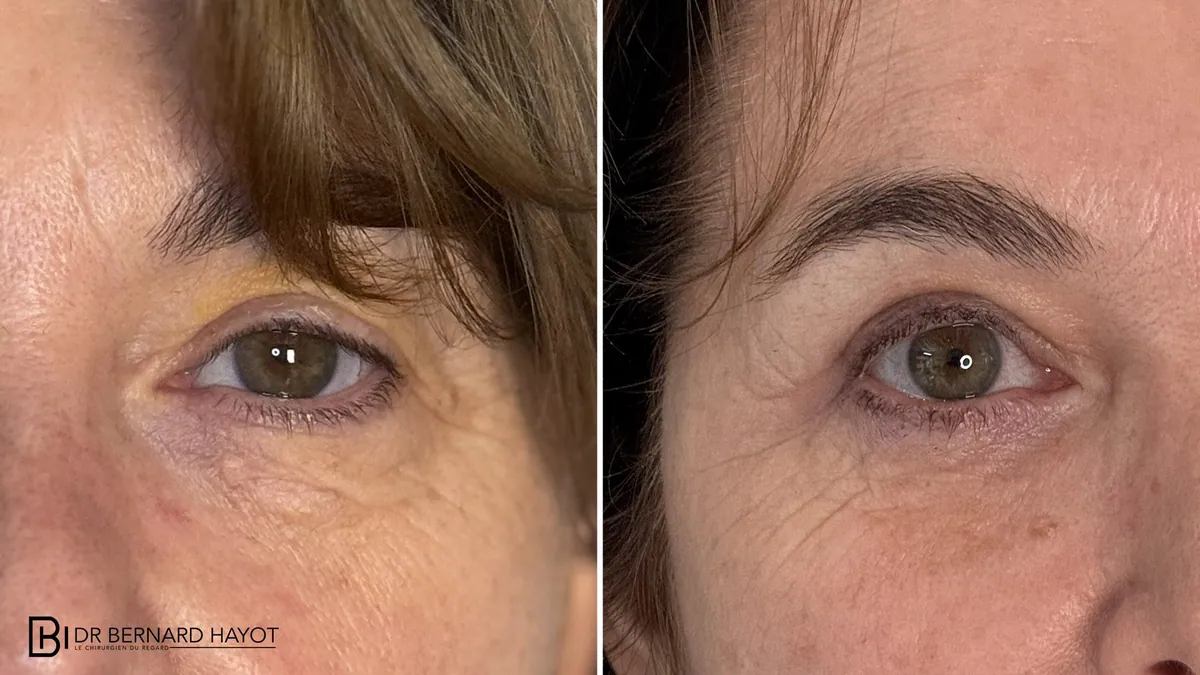
No cream removes excess skin: topical care acts on the quality of the skin, not on its excess nor on the position of the eyelid. What the examination finds decides the answer — surgical, medical, or both. After an upper blepharoplasty, the upper part of the eyes looks rested after a single procedure; the extent of the change depends on the anatomy and is discussed at the consultation.
After the procedure, a period of social downtime of 10 to 15 days should be expected, due to the appearance of swelling and bruising. After this period, the result obtained looks entirely natural, and the scars or other marks recalling the procedure are completely concealed, whose visibility depends on healing.
The advantages of upper blepharoplasty
Upper blepharoplasty makes it possible to treat the upper area of your eyes in a single procedure and offers many advantages over other methods:
- The procedure is tailored to each patient and involves no superfluous intrusive step.
- The scars associated with upper blepharoplasty are concealed, whose visibility depends on healing, as they are covered by the fold of your eyes.
- Upper blepharoplasty is a quick procedure performed on an outpatient basis and under local or general anaesthesia.
How an upper blepharoplasty proceeds with Doctor Hayot
The patient is received for an initial consultation in order to examine the face and the eyelids. An expert in blepharoplasty and an oculoplastic surgeon for more than 30 years, Doctor Hayot has genuine experience and advises you in finding the solutions best suited to your needs.
Advice before the surgical procedure
In order to minimise the risks associated with the procedure, Doctor Hayot gives you clear information so that you may approach the procedure in the best possible conditions. It is also recommended to stop all consumption of alcohol and tobacco for at least one month before the procedure, as this may have an impact on the healing of the scars. Care should also be taken to limit the intake of medicines and supplements that may increase bleeding (aspirin, ibuprofen, etc.).
How the surgical procedure proceeds
The surgical procedure takes place in the morning, after a fasting period of at least 8 hours. Local or general anaesthesia is administered. The procedure may last up to 1 hour 30 minutes, depending on the patient’s needs.
Postoperative advice
The postoperative course of an upper blepharoplasty is fairly mild. During the postoperative period, swelling and bruising caused by the procedure appear and last 10 to 15 days. It is recommended to rest for a week in order to speed up healing. We prescribe eye drops that prevent irritation of the cornea, the sensation of dry eye and conjunctivitis.
It is also recommended to apply ice-cold compresses for 2 days after the surgical procedure in order to help the swelling resolve. Care must be taken to avoid sun exposure and UV sessions for 3 weeks. Until the stitches are removed, no make-up should be applied to the treated area.
Should a lower blepharoplasty be performed at the same time as an upper blepharoplasty?
Upper blepharoplasty is a cosmetic surgical procedure for the upper part of your eye, whereas lower blepharoplasty is a surgical procedure carried out on the lower eyelids.
Depending on the patient, Doctor Hayot determines the surgical technique or techniques to be used according to what the examination finds. In certain cases, it is therefore possible that your surgeon will advise a lower blepharoplasty in addition to the upper blepharoplasty.
Do you also carry out surgical procedures on the lower eyelids?
Yes, we also carry out surgical procedures on the lower eyelids (lower blepharoplasty, pinch blepharoplasty).
Lower blepharoplasties are recommended in various situations: bags under the eyes, presence of dark circles, pigmented dark circles, etc.
During your first consultation, Doctor Hayot determines with you whether surgical treatment of your lower eyelids is necessary.
Price of upper blepharoplasty
The fee for an upper blepharoplasty varies according to the techniques used and to the patient’s needs. After the initial consultation, your surgeon draws up a full assessment of the treatment to be carried out and provides you with a personalised quotation.
The fees quoted include the surgeon’s fees, the anaesthesia, the costs relating to the operating theatre, to the staff and to the various products used.
How can an appointment be made with Doctor Hayot?
Doctor Hayot has specialised in oculoplastic surgery for more than 30 years. Appointments can be made from several cities in France such as Créteil, Lille, Nice and Neuilly-sur-Seine, in order to put in place a solution suited to your needs.
For any appointment request, please contact us by telephone, via our contact form or directly through Doctolib.
Can there be postoperative risks after a blepharoplasty?
The risk of postoperative complications after a blepharoplasty is very low:
- Conjunctivitis
- Healing problem
- Lagophthalmos
Most of these complications can be halted and treated with a suitable treatment. In the event of a more significant complication, Doctor Hayot may proceed with a second procedure.
Protocols, dosages and fees are never published here: they are determined at the consultation, after examination, and provided in writing in the quotation.
This page is for information purposes. It does not replace a consultation: each situation is assessed on examination.