
Treatment of drooping eyelids
Written and reviewed by Dr Bernard Hayot, ophthalmologist, RPPS 10003926226.
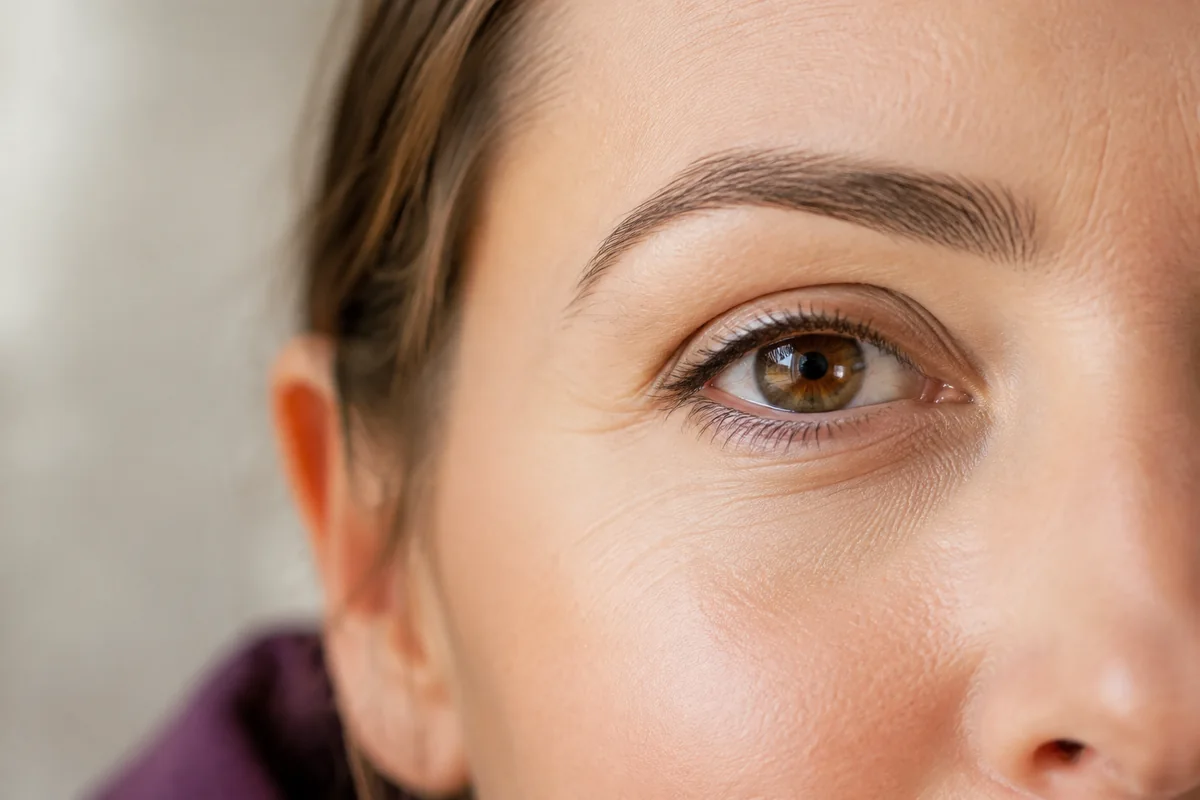
Droopy eyes: The oculoplastic surgeon’s diagnosis
The surgeon welcomes you to his aesthetic centre in Paris for an initial consultation. This meeting allows him to analyse in detail the characteristics of each patient: how has the face aged over the years? What is the texture of the skin? Have elasticity and collagen levels declined? Which treatments are best suited to correcting drooping eyelids?
Analysing a drooping eyelid is essential to finding the right surgical solution to treat it.
How to operate on drooping eyelids?
Dr Bernard Hayot, a specialist in eye rejuvenation, explains:
“The vast majority of cosmetic surgeons believe that excess skin is the only cause of drooping eyelids. For this reason, they tend to resect the excess skin with their scalpels to rejuvenate their patients’ eyes. But unfortunately, these methods hollow out the eyes more than anything else.
This surgical technique ends up giving the eye socket a cadaverous appearance and ageing the patient further. We need to think differently about eyelid & oculoplastic surgery. Not through skin resection, but through the addition of volume, in other words through addition blepharoplasty.
What does addition blepharoplasty involve?
Addition blepharoplasty is an eyelid surgery technique that recreates the volumes lost as the face ages. Dr Hayot shares his view on this technique, which he has mastered perfectly: “I believe that a drooping eyelid is, above all, an eyelid that has deflated, that has lost fat and, with it, the fullness of youth. This is why the skin then appears to be in excess relative to the fat that once filled it.
Find out more about the new technique of addition blepharoplasty and lipofilling.
What is the procedure for drooping eyelids?
As with any eyelid surgery, a minimum of 2 consultations with your oculoplastic surgeon is required. Dr Hayot’s consultations are held in Paris, London or Moscow. The oculoplastic surgeon will provide you with a detailed estimate for the operation and an informed consent form.
A visit to an anaesthetist will be mandatory to validate the feasibility of the drooping eyelid treatment.
An operating date is then set with the oculoplastic surgeon at your convenience. The procedure is performed on an outpatient basis, very quickly, and the post-operative course is generally straightforward.
On the day of your eyelid surgery, Dr Hayot may ask you to bring a front-facing photograph of yourself at the age of 20. He explains: “I need to analyse with my patients where and how much fat they have lost in the upper eyelid and across the whole orbital frame. I can then perform a customised addition blepharoplasty, down to the millimetre, injecting very small amounts of fat that allow me to rejuvenate my patients’ eyes quickly and discreetly.”
Have you already had eyelid surgery, or are you considering it? Leave a comment and share your impressions.
This page is for information. It does not replace a consultation: every situation is judged on examination.