
Treating dark circles with a tube of lipstick
Written and reviewed by Dr Bernard Hayot, ophthalmologist, RPPS 10003926226.
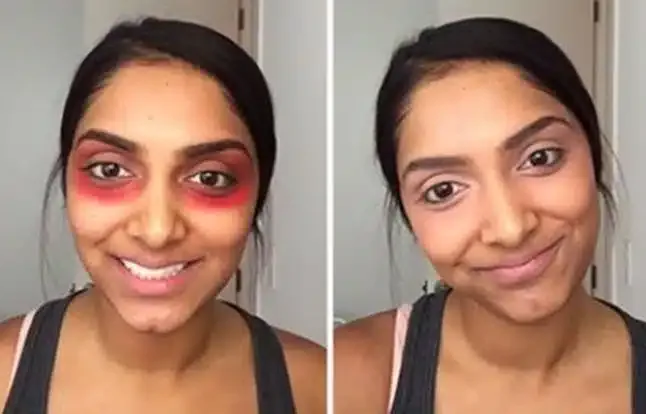
Treating brown and red dark circles
Lipstick: the new concealer?
What does this new technique actually involve? Think back to your art classes at school: on a colour wheel, blue and violet sit opposite red and orange. This means that orange-red is the most suitable colour for camouflaging dark circles.
Watch this video and discover how to put your lipstick to another use.
Treatment of dark circles
Dark circles are coloured when the skin of the lower eyelid is darker than the rest of the face. This colouring can take on different shades: brown, bluish, purplish or red.
This colouring accentuates a tired appearance, in the same way as hollow dark circles. Treating coloured dark circles is complex, because the causes are many.
If you want to correct your dark circles permanently, you will need to turn to aesthetic medicine techniques, which we describe below.
The different types of dark circles and the associated aesthetic medicine treatments
There are several types of dark circle. Here are their origins and the aesthetic medicine treatment associated with each type of colouring:
- Blue-violet dark circles
This colouring is caused by the transparency of the skin, which makes the bluish veins and the slightly purplish orbicularis muscle visible. The right treatment combines the FRAXEL® fractional laser, to “thicken” the skin, and microlipostructure, better known as lipofilling, to reduce the transparent appearance of the dark circles. - Red dark circles: laser treatment
Red dark circles are caused by the micro-capillaries at the inner corner of the eye. The dilation of these vessels can be due to heredity, to age or to extreme weather conditions. The KTP® laser is the best solution for removing red dark circles. The energy of the laser causes the vessels to retract and eventually disappear. - Brown or dark circles: the depigmenting peel
Hyperpigmented dark circles correspond to deep pigmentation spots and are often linked to heredity and to ethnic origin (North Africa, India and the Mediterranean basin) or to sun exposure. The Glyco Eye peel is the only truly effective, long-lasting treatment for dark circles of North African origin. Based on glycolic acid and lactic acid, this superficial peel treats the periorbital area effectively without irritating the skin of the lower eyelids too much.
Laser treatment of dark circles
The KTP and FRAXEL lasers are therefore good alternatives to surgery, as they involve no social downtime, and their results are proven for the treatment of blue or red dark circles. For brown or hyperpigmented dark circles, a depigmenting peel is recommended, as it is both highly effective and fast-acting in brightening and rejuvenating the eyes.
On the other hand,hyaluronic acid injections should never be performed in coloured dark circles, as this would aggravate the “Tyndall effect”: a transparency effect on thin skin that accentuates the bluish colouring of the dark circles. So, when the skin of the coloured dark circle is very thin and/or the pigmentation is associated with a hollow dark circle, a micro lipostructure must be performed in the operating theatre.
The benefits of laser treatment for dark circles
Laser treatment of dark circles has several advantages:
- No skin scarring
- No skin scar
- No sutures, and therefore no suture removal
- No post-operative oedema or bruising
To make the dark circles under your eyes disappear, book an appointment at Dr Bernard Hayot’s practice.
This page is for information. It does not replace a consultation: every situation is judged on examination.