
What are the different types of dark circles and how can they be treated?
Before / after
Real cases from the practice, unretouched, framed on the treated area only. Each result is individual and does not predict yours.
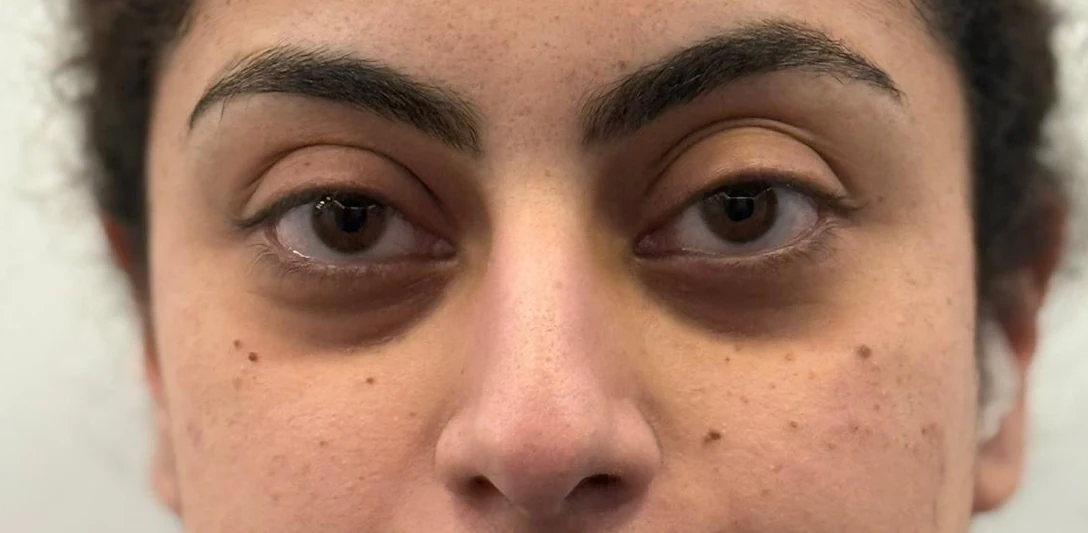
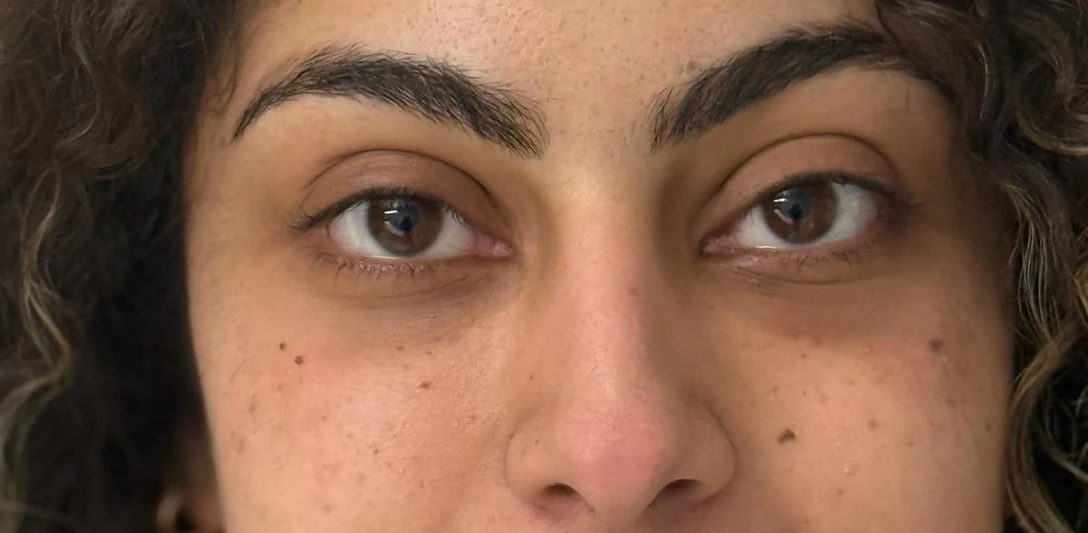
Photographs published with the patients’ written consent.

Dr Bernard Hayot, ophthalmologist, former Chief of Clinic, trained in oculoplastic surgery. Paris 8e · RPPS 10003926226.
Definitions and general points
What is a dark circle?
Not one dark circle, but different types of dark circles
There are different types of dark circles. Some patients will face hollow dark circles, which form a groove at the level of the lower eyelid. Others will have dark circles in the form of bags, which make them voluminous. These, in turn, are the result of an accumulation of water and fat under the eyes. Lastly, other people will have coloured dark circles, that is to say a groove at the level of the lower eyelid as well, but of a bluish, purplish or slightly brownish colour.
Whatever their nature, dark circles always bring the same discomfort and the same self-consciousness for the patient, namely an overly tired appearance.
How can you soften your dark circles?
Fortunately, it is possible to soften your dark circles, and even to rid yourself of them permanently.
Natural techniques
You may first opt for natural techniques by adopting good habits to combat dark circles: removing your make-up thoroughly every evening, applying a quality “eye contour” care product and gently massaging the area in order to optimise the effectiveness of your treatment. Many old wives’ remedies also exist (camomile, green tea, a spoon, ice cubes, lemon, and so on), so many that it is impossible for us to give you a detailed list!
Aesthetic techniques
The most effective techniques remain surgical. Dr Hayot, who specialises in eye surgery and the treatment of dark circles, generally recommends the following procedures:
- The microlipostructure of the hollow dark circle
- Nano-lipofilling for coloured dark circles
As you will have understood, the first operation aims to eliminate hollow dark circles and to attenuate the “tired” aspect of the gaze. The volumes that have melted away are then restored by means of a fat transfer taken from the patient themselves. Indeed, after liposuction carried out in the abdomen or on the inner side of the knees, by preference, the fat is treated (rinsed, cleaned, defibrosed), then reinjected into the dark circle using a microcannula.
Note that when bags under the eyes are associated with hollow dark circles, Dr Hayot may propose, in addition to the microlipostructure of the dark circle, an ablation of the bags by the transconjunctival route with the laser scalpel.
For coloured dark circles, one of the effective techniques is nano-lipofilling. This highly specific operation consists in coating the dark circle with stem cells and growth factors extracted from the patient’s own fat. The dermis then thickens within a few weeks and the effect of transparency disappears.
Note that other aesthetic medicine treatments exist, such as the laser, hyaluronic acid injections, peels or fractional radiofrequency. Their results are, however, far less visible and lasting than those of a surgical operation. They sometimes even worsen the initial condition of the dark circle if they are poorly performed.
An ophthalmologist, Dr Hayot receives patients in consultation at his Paris practice. Please do not hesitate to contact him.
Protocols, dosages and fees are never published here: they are determined at the consultation, after examination, and provided in writing in the quotation.
This page is intended for information. It does not replace a consultation: each situation is assessed on examination.